Monday, 28 November 2011
Desperate measures
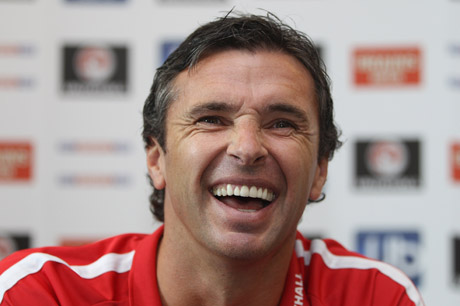
The shock of Gary Speed’s death is the perfect example of how depression works. Outwardly a man with everything; success, talent, love, support, friends and family, money and acclaim. No clues. No fear for his safety. Pure disbelief.
Of course his is one of many suicides over the weekend but his high profile in the British media casts more light that usual upon this death, and the manner of it.
And once again makes people who have never suffered, or felt any urge that the world, and the people in it, would be better off without them, screw their brows in consternation.
It is one of those things that cannot be described to those free of depression.
The weight, the feeling of utter contempt for oneself, the sureness that you are ruining the lives of those around you. Your total USELESSNESS. The belief that your mental state is adversely affecting the very people you want to protect from your depression.
The cycle is truly vicious.
I have tried to deal with my particular form of the illness in my own way, but the more you understand it the more you realise that these are patterns that are replicated in so many other lives.
The need to close off from everyone and everything. Draw the curtains, ignore the phone, the post, the knock at the door. Withdrawal. Then comes the paralysis of action. A complete exhaustion that renders the sufferer unable to function properly, even for the simplest task. Anyway, the suffering of depression has its many forms, I wont list them here, it is pointless, only those who know, know.
Instead let’s look at one of the key issues raised by Gary Speed’s death. That no-one knew. Everything he had achieved, everything he had in life he did with the real man hidden from view. This is the experience of so many sufferers. We must not, can not, open up to other people, it is the pure evil nature of depression that when in the midst of it you will not tell people to avoid worrying them. And once it has past, be it a day, three, a week, a month, your brain comes out fighting and you hope and HAVE to believe that it will not return. Or at the very least revisit a long, long time it the future, when maybe you have learnt to deal with it better. Yes, next time you’ll see it coming and hide it even better than the last time.
Of course we understand the absurdity of being depressed in a time and place where we have more than any human beings have ever had; living longer, more affluent, safer, healthier, there should be nothing to worry about right?
Right. Yet another reason for the guilt and silence. We have no right to be depressed. We are spoiled brats moaning about how awful life is when we should be living the dream of consumerism and enjoying the vac-packed green beans flown directly from Kenya for our stir fry. The ridiculousness and irony of the illness is more than apparent.
So many geniuses and brilliant people are, or were depressive – many are sadly no longer with us because they could not go on with the pain they carried around.. You don’t need me to google them for you, but the list is long and sad and sobering.
My own life has been affected by the suicide of my Dad’s father when my Dad was 15. The ripples still float out and reach people he never even knew would exist.
Recently we have had insight into crushing depression from Stephen Fry amongst others. But the stigma remains.
So the next time a friend doesn’t return your text message, or ignores your calls, or you want to tell them ‘everyone gets down sometimes’, or ‘pull yourself together’ or ‘just get on with it’ maybe they need a little less judgement and a touch more understanding.
And maybe we can help create an environment where both men and women can articulate their desperation without fear. Maybe the desperate silence can be avoided if more ears are open. And maybe less families will have to go through the numbing, sickening loss and grief that Gary Speed’s family are experiencing right now.
Love, respect and peace to you all.
Friday, 23 September 2011
Real books V Kindle
I had a look at a Kindle for the first time yesterday and as much as I tried to have an open mind (I didn’t) I wasn’t surprised to find I hated it.
I felt exactly the same as the first time I used a CD. Before CD’s (and the even more detached itunes) we used to know the names of tracks, and the order of them and we had a solid connection to the art itself, an LP or single was a beautiful, colourful, tactile delight, before you even discovered the music that was going to shape your life.
The lovely little messages etched into the smooth vinyl, the hiss and crackle, the turning over half way through, the placing of the needle on the groove, I loved it all.
So forgive me if I cannot get excited about staring at a piss-poor electronic screen, a soul-less window that further distances me from the mind and hand of the author.
‘But they’re really good, you can have hundreds of books at once’.
I don’t want hundreds of books at once, I want to have a relationship, organic and growing, with the book in my hands, the book that has been crafted and sweated over, a direct connection from the creative brain through the hand to the page and into my brain.
I want to finish it and caress its cover and kiss it, as I have done with many books that have delighted me and lifted my spirit.
Most recently Lean On Pete by the wonderful Willy Vlautin. (I had to go into the spare room and have a little cry).
I could never feel the same about reading the new Douglas Coupland or James Frey direct from a grey screen, or discovering the joys of Carey or McKewan or Bukowski (as I have recently) via a toy.
I’m sure I’m wrong, I often am when it comes to things that I perceive to be pointless that take over the world. U2 (thought they would be gone by the end of ’83), Madonna (I predicted Cyndi Lauper would have more longevity) the internet (‘what’s the point of that? It’ll never catch on’. Me, circa 1998.)
Nothing can compare to finding a tatty copy of The Ravens, the Count of Monte Christo or Papillon whilst back-packing in some small backstreet second-hand book exchange in Bangkok or Hanoi, and adding to its well thumbed life.
Taping it up with gaffer tape and then passing it on for someone else to have a mind altering experience.
Or in some cases bringing it home and having it proudly on your bookshelf as a memento of another time (my copy of Sideshow I bought at the entrance to the killing fields in Cambodia still give me a frisson of revulsion and fascination whenever I glance its cover on the bookcase at the top of our stairs.)
Books play a huge part in our lives, both myself and the future Mrs. L (although I’ve been informed she wont be taking my surname. Very wise) love to discover new authors and new series and buy them one after the other until another new bookcase is required. Will we really feel the same just having a list of tracks on a box?
I’m certain I never will.
In much the same way DJs, dance music and mixing saved vinyl I’m hoping that the huge number of comics and graphic novels that are produced monthly and yearly will protect printed media.
I for one will not be buying a Kindle and I hope for the sake of protecting the poetic soul in all of us neither will you.
Just read: Lean On Pete by Willy Vlautin.
Now reading: The Terrible Privacy of Maxwell Sim by Jonathan Coe
Listening to: God hates a coward by Tomahawk.
Wednesday, 10 August 2011
Drunk is poetry
As human beings continue their never ending search for self destruction I thought a light-hearted missive might be in order.
I was reading something or other not long back (Wodehouse I think) when a drunken character was described as ‘in his cups’.
A delightful expression I thought and it got me thinking.
What other expressions for drunkenness are a credit to the English language?
In my time I’ve heard, or used, wankered, twatted, pissed, muntered, bladdered, battered, hammered, arseholed, plastered, caned and of course the ubiquitous fucked; the list goes on.
But what of those expressions that show the true diversity of this jewel of languages? That illustrate the endless possibilities of English to articulate one state of being in countless ways.
‘In his cups’ I particularly like, and is possibly of Roman or biblical origin.
‘Shedded’ is one I’ve heard and apparently is short for ‘my shed has collapsed and taken most of the fence with it’. Possibly not the easiest way to verbalise your drunkenness.
The Aussies have given us ‘paralytic’ since the early 20th century, and ‘shot full of holes’, which they lifted from the Kiwis in world War One, and good on them for it.
‘Smashed’ sounds like it’s a modern invention to me, but comes from an old American saying ‘smashed as a brandy peg’. Smash being a type of brandy apparently.
‘Pickled’ is wonderful, as is ‘piddled’. ‘Pie-eyed’, is a peculiarly American term that reached our shores in the late 1800’s.
It’s amazing how each word or expression brings to mind a very specific level of drunkenness. A man who was ‘tipsy’ or ‘squiffy’ or ‘sozzelled’ wouldn’t hit his wife would he? But someone who is ‘tanked up’ might.
They are also, like much slang, time capsules that appear and disappear in short time periods. ‘Swipey’ for example is recorded from 1844 but had pretty much died out by 1900, ‘rat-arsed’ is a wonderful newer invention, first heard from teenagers in the ‘80’s.
In the late 1700’s you might have ‘swallowed a hare’ or if in port ‘swallowed a sailor’. Something that might get you an odd look in Brighton in the 21st century.
The 1920’s had a string of lovely descriptions that really put you right there amongst the flappers; ‘ossified’ ‘spifflicated’, ‘canned’, ‘corked’, ‘scrooched’, ‘jazzed’, ‘zozzled’, ‘owled’, ‘embalmed’, ‘lit’, ‘potted’, or ‘fried to the hat’.
All of which applied presumably to that wonderful chronicler of the jazz age F. Scott Fitzgerald.
The amount are incredible, the diversity staggering, it’s a book topic not a blog entry so I’ll leave you to seek out you own and bask in the glow of our wonderful language.
And forgive me if this blog entry is a little disjointed, I was at a friend’s stag do last weekend and was ‘crapulent’ to the point of being as ‘stewed as a fresh boiled owl’.
Just read: Ham On Rye by Charles Bukowski
Listening to: Official sountrack to the motion picture Kick Ass.
I was reading something or other not long back (Wodehouse I think) when a drunken character was described as ‘in his cups’.
A delightful expression I thought and it got me thinking.
What other expressions for drunkenness are a credit to the English language?
In my time I’ve heard, or used, wankered, twatted, pissed, muntered, bladdered, battered, hammered, arseholed, plastered, caned and of course the ubiquitous fucked; the list goes on.
But what of those expressions that show the true diversity of this jewel of languages? That illustrate the endless possibilities of English to articulate one state of being in countless ways.
‘In his cups’ I particularly like, and is possibly of Roman or biblical origin.
‘Shedded’ is one I’ve heard and apparently is short for ‘my shed has collapsed and taken most of the fence with it’. Possibly not the easiest way to verbalise your drunkenness.
The Aussies have given us ‘paralytic’ since the early 20th century, and ‘shot full of holes’, which they lifted from the Kiwis in world War One, and good on them for it.
‘Smashed’ sounds like it’s a modern invention to me, but comes from an old American saying ‘smashed as a brandy peg’. Smash being a type of brandy apparently.
‘Pickled’ is wonderful, as is ‘piddled’. ‘Pie-eyed’, is a peculiarly American term that reached our shores in the late 1800’s.
It’s amazing how each word or expression brings to mind a very specific level of drunkenness. A man who was ‘tipsy’ or ‘squiffy’ or ‘sozzelled’ wouldn’t hit his wife would he? But someone who is ‘tanked up’ might.
They are also, like much slang, time capsules that appear and disappear in short time periods. ‘Swipey’ for example is recorded from 1844 but had pretty much died out by 1900, ‘rat-arsed’ is a wonderful newer invention, first heard from teenagers in the ‘80’s.
In the late 1700’s you might have ‘swallowed a hare’ or if in port ‘swallowed a sailor’. Something that might get you an odd look in Brighton in the 21st century.
The 1920’s had a string of lovely descriptions that really put you right there amongst the flappers; ‘ossified’ ‘spifflicated’, ‘canned’, ‘corked’, ‘scrooched’, ‘jazzed’, ‘zozzled’, ‘owled’, ‘embalmed’, ‘lit’, ‘potted’, or ‘fried to the hat’.
All of which applied presumably to that wonderful chronicler of the jazz age F. Scott Fitzgerald.
The amount are incredible, the diversity staggering, it’s a book topic not a blog entry so I’ll leave you to seek out you own and bask in the glow of our wonderful language.
And forgive me if this blog entry is a little disjointed, I was at a friend’s stag do last weekend and was ‘crapulent’ to the point of being as ‘stewed as a fresh boiled owl’.
Just read: Ham On Rye by Charles Bukowski
Listening to: Official sountrack to the motion picture Kick Ass.
Riots? same as it ever was.
I find myself somewhat conflicted over the current spate of rioting that’s breaking out like unsightly zits all over this country. My natural left-leaning nature is being sorely tested by a sneaky little right wing side of me that is inflamed by certain aspects of modern society.
Whilst rioting itself is nothing new, in London or anywhere else, and will always be part and parcel of life in Britain (my favourites are the Luddite riots of the early 19th century. They smashed machines up, these current ones were organised on Blackberries. Go figure)
I can’t help feeling that what these youths need is a bloody good hiding. To quote Pink Floyd ‘a short, sharp shock’.
But how can I have such a violent lurch to the right? Am I, indeed, becoming more conservative as I get older?
The 20-something me would have delighted in the chaos and anarchy, but then what did he know?
Nothing, he was an idiot.
And that’s the main issue here, young people are stupid. I’m not talking about the remarkable kids that appear week after week on University Challenge, who are au fait with the laws of motion, the pelvic bone of the Amazonian tree frog and the periodic table, they are a different breed and we’ll need them later. They’ll probably be the ones in 30 or 40 years sitting on committees trying to work out what should be done about the rioters in New London smashing up hover car showrooms.
No, the problem we have is that to be young means to know better than everyone else, when actually you know the square root of fuck all.
And how the youth enjoy their ignorance, it’s a badge of honour to know nothing, but they still demand respect for doing so. See, I can feel a rant coming on. And that’s no good. Regardless of the feelings they evoke we need to look at the issues that have caused these riots.
Could it be that creating not only a society, but a entire civilisation, on consumer greed, envy, 24 hour advertising, bad credit and a scrabbling need to possess ‘things’ and ‘stuff’ to fill the empty voids in our lives that used to be filled by blindly following God and King and Country, might have been a bad model?
But that’s the dream we’ve been sold and as long as uneducated disenfranchised young people, whose own parents were the same, keep being told what they ‘deserve’ without being given any means of achieving it we’ll continue to reap what we sow.
How are your cuts to public services looking now Prime Minister?
Reading: The Wine-Dark Sea by the incomparable Patrick O'Brian
Listening to: Mozart's Flute Concerto No. 1 in G Major, amongst others
Wednesday, 22 June 2011
Blinkers on
So I have 50,000 words of the novel now and it is rapidly slithering out of control.
Writing a film script is tough, writing a novel is tougher. At least in the first draft. With film you have a specific scene, you decide what order you want those scenes, I use index cards, other systems are available, then you get the charcters in the scene, you decide what they want, and then you put obstacles in their way, then you see how they get what they want.
Conflict is all. Economy of words, and what is happening between the lines is all powerful.
The trouble with prose is that you are able to go on flights of fancy. Without the rigid parameters imposed (necessarily) by screenwriting, the mind wonders, it tries to cram in every aspect of the scene, every sense must be catered to, every whim of the mind appears on the page. Both mediums are hard, very hard, to get right, but with prose every little idea has a knock on effect, your mind recalls snippets of conversation, moments in the past, a look from a former lover, an awkward moment from a conversation over 20 years ago, a perceived slight at the hands of someone older, a hairbrush tangling in the hair, a smell, a taste. It's really quite distracting.
But then I suppose that is what a writer must do, like actors we are only at our best when our emotions are right up there at the surface, able to draw on every tiny aspect of our lives. It is not a healthy thing we do, days pass without proper connection or conversation with others. The curtains remain drawn, the door remains locked, and we chip away trying to get that word or phrase. We are as Robert Downey Jnr pointed out at the Oscars, 'the sickly little mole people'.
Is it worth it you may ask?
I think so yes, you don't choose writing it chooses you. As with all art forms. You can ignore and let the 'what if?' thoughts fester in your soul, or you can take a leap and get it out of your head and onto the paper, where is lies lifeless and not what you felt it should be. You then work on it, work on it, work on it, try to get every word exactly as you want it. A myriad doubts linger, keep you awake, make you think 'this is pointless'.
And then what?
You have to let other people read it, and give you their opinion.
OTHER people.
THEIR opinion.
What new hell is this?
So the novel oozes onward, the story loses shape, the friends read it and think, what exactly? Even if they tell you they like it do they really? Are they merely stroking your ego out of kindness?
Who knows?
You must just keep going and hope that when you get to the top of the mountain all that time spent with your face up against the rock was worth it.
You must look at the view, enjoy it, feel the accomplishment, feel the achievement.
And then?
You have to rewrite and edit, every single word, every single page, whilst keeping the whole end product in mind.
You've reached the top of the mountain. Now you must lower yourself safely down.
And hope the rope doesn't break.
Reading: MIND GAME: How the Boston Red Sox got smart, won a World Series and created a new blueprint for winning by the writers of the Baseball Prosectus.
Listening to: Troublegum by Therapy?
Monday, 13 June 2011
Rendezvous with destiny
Apparently every person who chooses to join the armed forces nowadays is a hero. Not the word I would choose. A hero is someone who does something heroic. Not someone who puts themselves into the possibility of harm’s way, that may then lead to them doing something heroic. Perhaps. I’m not disputing they are brave, but heroic? No.
I was thinking about this the other day because it came to my attention that a rather amazing chap passed away this year. A man who in my own understanding of the word is ‘heroic’.
Dick Winters was not someone I grew up knowing anything about, unlike Douglas Bader and Guy Gibson, whose derring-do was drummed into me at school. No, Winters was a man I read about in Stephen Ambrose’s brilliant ‘Band of Brothers’ and then watched being portrayed by Damian Lewis in the remarkable mini series of the same name.
Born and raised in Pennsylvania he was a high-achiever at both school and college and upon the U.S. entering World War Two, he joined up. He excelled again in training and was selected for officer candidate school. He heard of a new regiment, one that used parachutes to jump into action, a new form of combat elite, and was sent to the 101st Airborne division at Camp Taccoa, Georgia.
More strenuous training was endured, the drop out rate was high, Easy company, Winters’ company, sailed to England and set up in Wiltshire. More training followed, Winters was now leading 1st platoon.
They all knew their day would come.
In the darkness before the land assault on D-Day Winters and his men flew into heavy fire over the Channel, many of the C-47 planes were torn to shreds or blown clean out of the sky, losses were huge. The men stood in their stick in the noise and the Ack-Ack and the hail of fire then jumped out of the planes over France. Many were shot on the way down, many perished hitting trees or were drowned in rivers and other waterways, some survived.
Dick Winters, unaware their commanding officer had been killed, and without any weapon or equipment, rounded up 13 men and attacked a howitzer battery of some 50 Germans artillery men. The guns were trained on Utah beach. The assault knocked out the guns, killed, wounded or captured every enemy soldier and is taught at Westpoint to this day as the perfect way to take on a fixed position against superior numbers.
He was awarded the DSO and promoted to Captain.
In Operation Market Garden he led from the front again, taking out a group of SS infantry of 300 with one platoon.
In the Battle of the Bulge, with Winters now as battalion XO, the 101st were completely surrounded by 15 German divisions supported by heavy artillery, for a week, the line was thin, the cold was brutal, the shelling was constant, casualties were heavy, but they held. Winters then led his men to assault the town of Foy. They took it.
He became Major, and acting battalion commander of 2nd Battalion.
They moved into Germany and were given orders to capture Hitler’s Eagle’s Nest in Berchtesgaden. They were sunning themselves on the balcony enjoying the contents of Himmler’s wine cellar when the word came the war was over.
Eventually Dick Winters returned to the U.S. he married, raised a family, got more education from Rutger’s, through the GI Bill, excelled in a number of companies, began his own. He continued to lead by example, training officers, giving talks on leadership and attending reunions with his friends and comrades. He built a house on quiet farmland back in Pennsylvania.
Some quotes from his memoirs bear repeating:
Lead from the front. Say, “Follow me!” and then lead the way.
Remain humble. Don’t worry about who receives the credit. Never let power or authority go to your head.
Hang Tough!--Never, ever, give up.
In a world were the word hero is banded about a little too often for my liking I’ll stick with Dick Winters, and those other men of the Screaming Eagles, who left their jobs and lives in big cities and small towns and threw themselves out of planes into the inky night engulfed by violence and death because they believed that to not do so would lead the entire world into darkness.
Dick Winters reached his ‘Rendezvous with destiny’ in January. He was 92.
Reading: Tales of ordinary madness by Charles Bukowski
Listening to: The Velvet Underground by The Velvet Underground
Wednesday, 11 May 2011
Castaway
There has been a steady stream of hideousness in the news, despite the media’s obsession with deflecting us away from the stories that matter, based around two wealthy people getting married. I’m steering clear of all that for now as there has been something that is so wonderful and life-affirming I am in a state of utter delight every day I sit at my desk.
BBC Radio 4, described, quite rightly, by Stephen Fry a few years back, as one of mankind’s greatest achievements, has released the last 500 Desert Island Discs, available to listen to on the computer whenever you like. I’m in heaven, the opening bars of the music alone (By the Sleepy Lagoon by Eric Coates) has me in a state of excited anticipation and total relaxation.
The perfection of radio, the intimacy, the privacy, the feeling of being in a special place, alone, listening to remarkable people who have lived remarkable lives, is pure joy. To be able to relive those I’ve adored and discover ones I’ve missed is wonderful.
The website says it is trying to sort out all of the recordings since the series began in 1942. I’m fervently hoping they do, I can’t wait to hear the thoughts and favourite music, the odd luxuries and the great books choices, of people such as Celia Johnson, Michael Redgrave, Guy Gibson, Alfred Hitchcock, Frankie Howerd, John Osbourne, Alan Bennett, Bill Shankly, anyway, you get the picture.
My fingers and toes are crossed.
It’s hard to explain my feelings about DID, maybe it’s a throw back to my pre-teen years, lying in bed with my head under the pillow, listening to my little red transistor radio, gripping the plastic handle as I heard of exotic locales, derring-do and the mysteries of the universe via scratchy voices that made the world seem so vast it was beyond comprehension. It felt like I was the only person listening, and at its best created an excitement and tension that no other medium can match.
One of my greatest hopes growing up was that one day I’d be on there, picking my tunes, dissecting my life, and discussing how I’d survive on a desert island. Such a simple concept, and yet it creates the most engaging portrait of those who participate, getting underneath the public persona, lifting the lid on what makes these people tick whilst making us think and smile and empathise.
To imagine something being created now that is still running, and as good as ever, in 60 years time is almost impossible to imagine, but DID will be that age next year. A remarkable feat that is a testament to it’s creator Roy Plombley and the simpler days of pitching ideas, where someone said ‘I’ve good idea’ and someone else said ‘let’s do it’, as opposed to the myriad bullshit of focus groups, test audiences and endless coffee drinking that surrounds the creation of ANYTHING artistic nowadays.
So I live in hope that it survives another 60 years and fills many more lives with joy and maybe, just maybe, if I work hard enough, get lucky enough and sell enough copies of my novels etc I will make it on the show to tell them I don’t want the bible, but do want a lifetime supply of pick n mix.
Well I’m off, I’ve been listening to Martin Pipe’s and Nick Hornby’s and Ricky Gervais’s and now it will be Morrissey’s.
Marvellous.
The world is not all doom and gloom afterall
, sometimes there’s simple genius.
Reading - The last testament of the holy bible by James Frey
Listening to - Live on the Sunset Strip - Otis Redding
Subscribe to:
Posts (Atom)


